 Facebook
 Twitter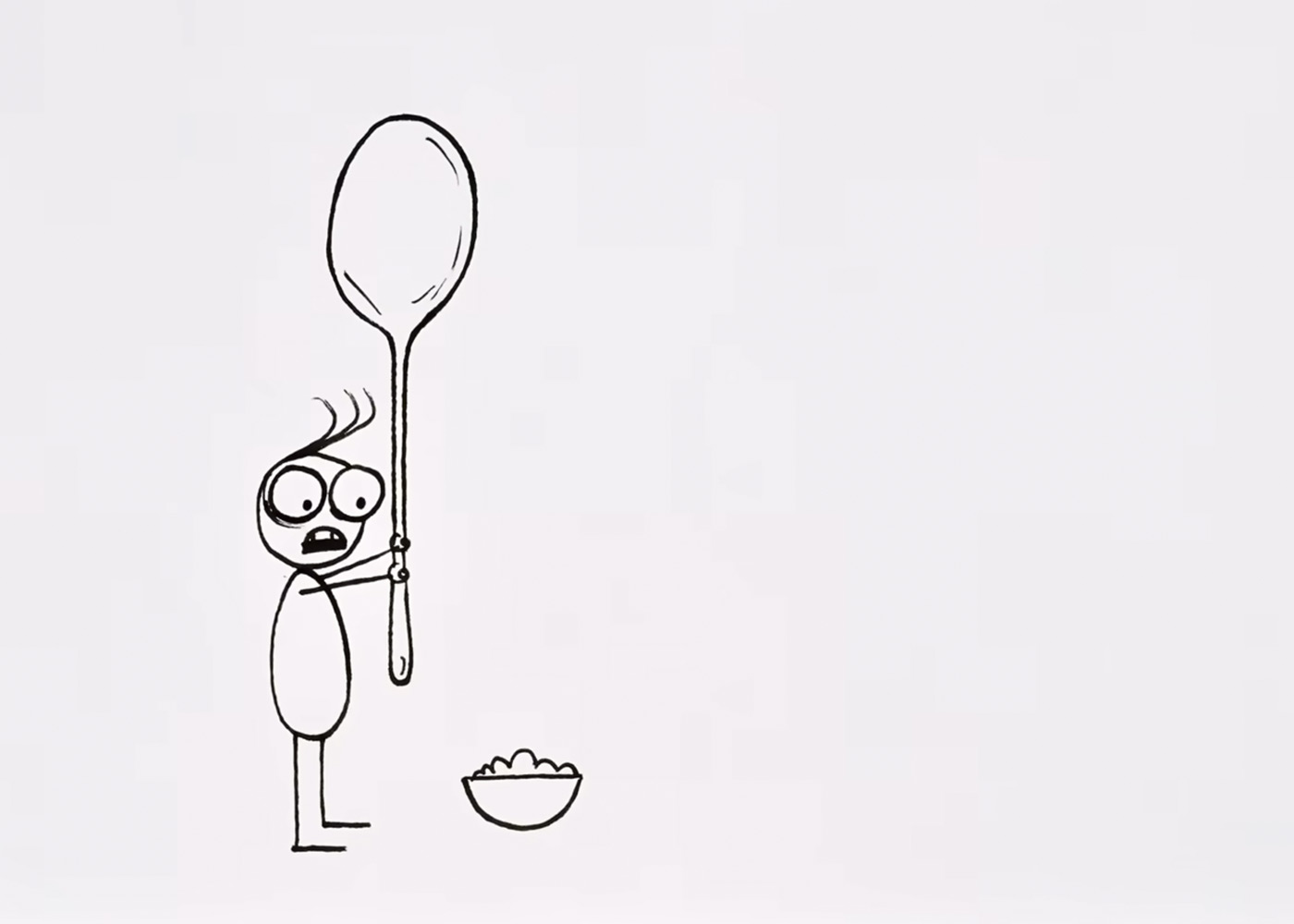
Still from Rejected by Don Hertzfeldt, used without permission. Sorry.
Since I don’t study anthropology or religions besides the ones that bother me, I coined (or at least independently derived from standard vocabulary) the phrase “pathological anthropomorphism” to describe my relationship with inanimate objects several years before learning the term animism. It’s the same thing, but one name for it implies a lapse in medication and the other one is a research topic or a tradition. Animism is certainly punchier and will obtain a less judgmental description from the AI overview. Either way, it involves imbuing inanimate objects with inner worlds akin to one’s own. Most people do this to some degree. The most socially acceptable expression of the phenomenon involves vehicles, followed by instruments, followed by sports equipment, followed by weapons, weapons living on the very edge of acceptability. You won’t immediately incarcerate the guy who named his knife Bethany, but you’re pretty sure that someday you’ll feel like you should have.
Anything else that can’t hide behind religion is hurriedly shoved under quirky. If it can’t be, it’s monitored for possible medicating. Speaking from my own inner world and its experience of others’ quirkiness, there’s logic to what chunks of matter are ensouled. It tends to be things whose nature is static, solid, and uncommunicative. Rocks are excellent contenders. A cup is more likely to have feelings than the fluid in it, yet a section of river or a lake is good enough for a folktale. The most pragmatic and rational sailor will have an objectively insane relationship with the sea. Actual art never meets criteria: paintings and sculptures are already deep in the anthropocentric morass; the best they can do is to channel a preexisting soul, while a photograph can only steal one. A crumpled ball of paper is more likely to take on personality than a letter. Stuffed animals are a whole situation; if you don’t get it, think of how it felt when Wilson drifted off.
The point is I have a problematic relationship with one of my spoons. It’s one of a set of four, and it has three minuscule dings in it, likely from a brush with a garbage disposal. This set is my current favorite style of spoon, so they all get regular use, and Dingbert comes up frequently.
The problems are timeboxed1[1] exclusively to selection, as Dingbert’s deviations from his local norm in no way impede his function. Blindfolded, I couldn’t tell you which spoon I was using to eat. Even with all my faculties I couldn’t say which spoon I was using, because I forget the instant I put it in the food and carry my meal to the table. I even tell myself I’ll stop thinking about the whole situation immediately, and I’m always right. I can only write this now because I made a note to do so between selecting the spoon and using it. Everything that rattles around my head about Dingbert does so in the four seconds it takes to transfer him from the silverware drawer to a bowl.
Yet rattle it does. In the beginning, it was just a mar. A purely aesthetic flaw; as already stated, it changes the experience of use in no way at all. A tiny break in symmetry with its coworkers, but far from subliminal. Dingbert is clearly different. Perhaps once I wondered about the person in a party of four who got Dingbert. I can imagine the person who would feel slighted, and ask for a purer form of the spoon to ensure interchangeability of social status. I can imagine the person who would feel lucky, or the party who always demanded this same set of spoons and whoever got Dingbert didn’t have to pay.
Whatever overthinking I did about how hypothetical people would encounter Dingbert quickly infected my ideas of how I should encounter him. Did I detect a hint of disappointment in myself when he happened to be at the top of the spoon pile? That seems unfair, so time to overcompensate by preferring him. “Hello, old friend,” started sounding in my mind’s ear whenever I picked him up. But now was I being unfair to the others? They didn’t even have names! Even if I tried I would have to name them all the same thing, and any name from Jim to Squirkle38 would only be a pseudonym to hide their real identities as Not Dingbert. A new, more complex resentment began to mold around Dingbert, because now I had to manage a whole four-point theory of dignity because he had the audacity to throw himself in a garbage disposal.
As the relationship matured in four-second increments, Dingbert became one among spoons. A broadened definition of my favorite spoon took over. They were all equally capable, after all. The unavoidability of being aware of dissymmetry within an arbitrary standard does not dictate action. Best to discard that which is arbitrary. It’s hard because I don’t understand where my feelings come from. Why do I even respond to something not even displeasing, only different to the precise degree that I can register it as different? Yet the feelings keep crawling out to derail my train of self-justification.
I really went through this with spoons. Look:
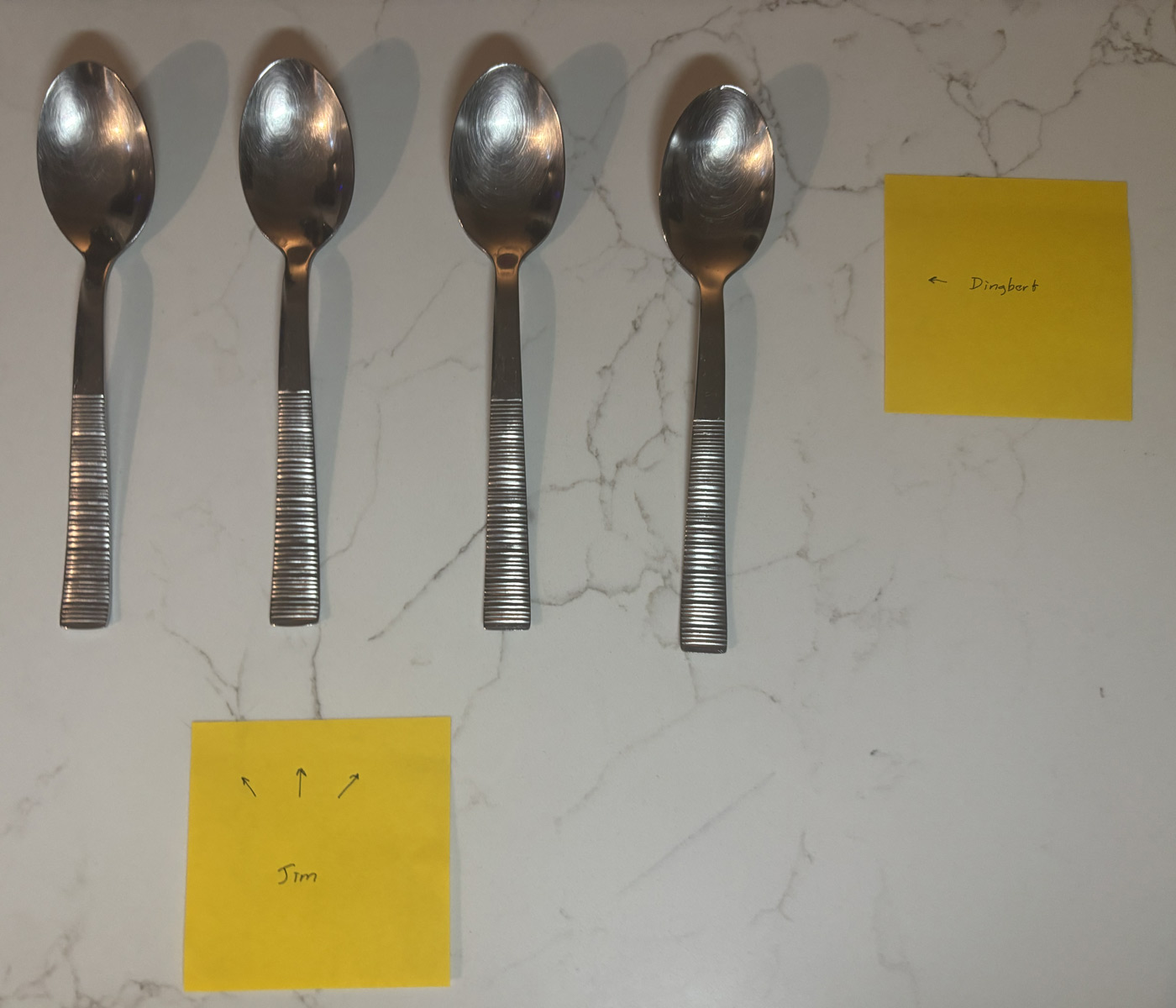
Non-metaphorical silverware.
1 I’m lifting this word out of software development because it’s too good to be left to rot.